
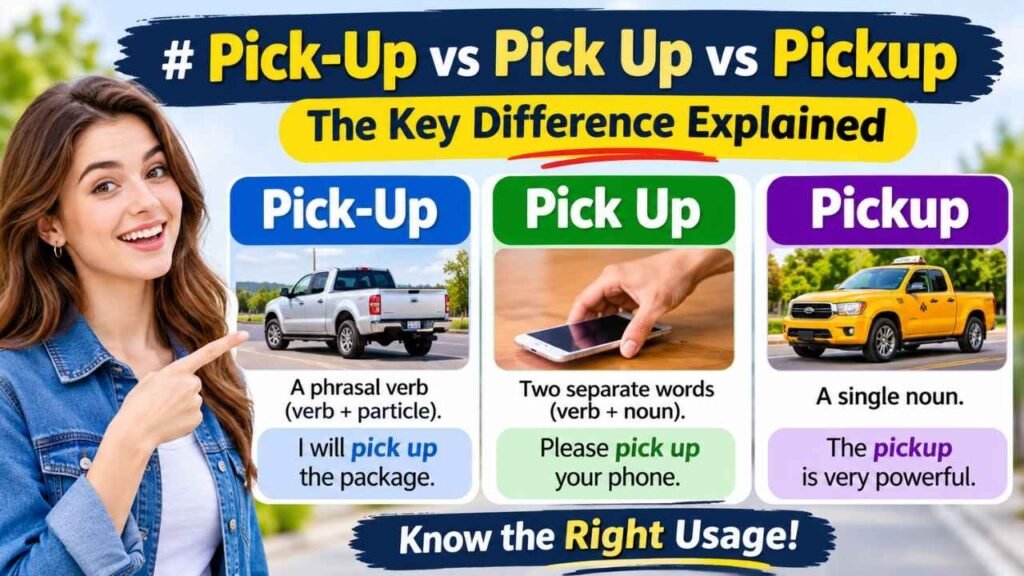

Have you ever wondered whether to write pick-up vs pick up vs pickup? These three forms look similar, but they serve different grammatical purposes. Choosing the correct one depends on whether you are describing an action, naming something, or using a word to describe a noun.
The good news is that the difference is easy to understand once you learn a simple rule: pick up is generally a verb, while pickup is a noun or adjective. Pick-up is also used as a hyphenated noun or adjective variant.
Quick Answer
Pick up is a two-word phrasal verb that describes an action, such as lifting or collecting something. Pickup is a one-word noun or adjective referring to a collection, vehicle, or service. Pick-up is an alternative hyphenated form used as a noun or adjective. Choose the spelling according to its grammatical function and your preferred style guide.
What Is the Difference Between Pick-Up vs Pick Up vs Pickup?
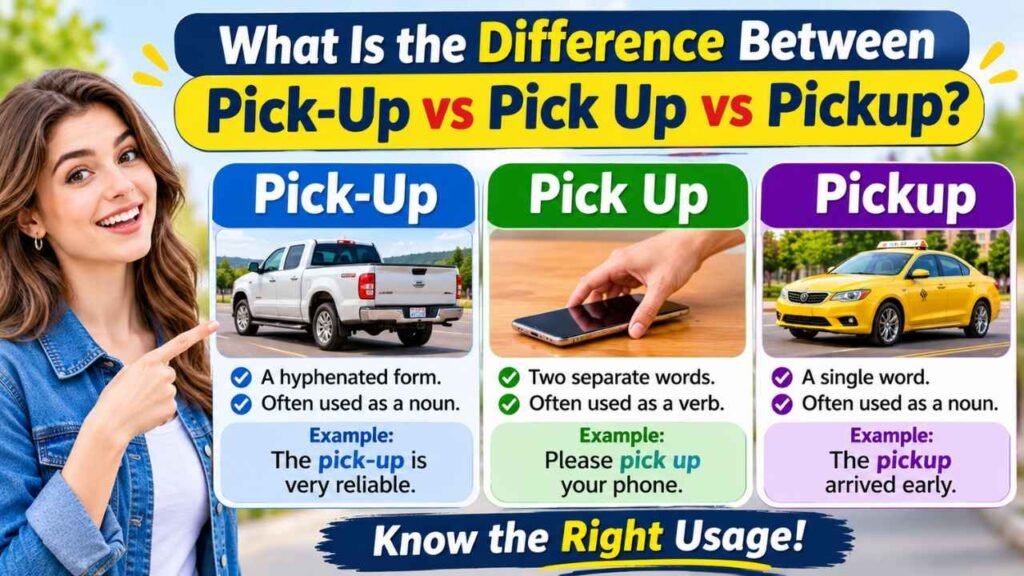
The main difference is how each form functions in a sentence. Although all three are related to the same word, they are not interchangeable in every situation.
Here is a quick comparison:
| Form | Grammatical use | Example |
| Pick up | Phrasal verb | Please pick up your bag. |
| Pickup | Noun | The pickup is scheduled for noon. |
| Pickup | Adjective | I drive a pickup truck. |
| Pick-up | Hyphenated noun/adjective | We arranged a pick-up. |
Pick up describes an action performed by someone. For example, you can pick up a package, pick up a child, or pick up a book.
Pickup usually identifies a thing, event, or service. It can also describe another noun, as in pickup truck or pickup location.
Pick-up is another accepted spelling in some contexts, particularly in hyphenation-based styles. However, the one-word spelling pickup is generally preferred in modern usage.
When to Use Pick Up (Two Words)
Use pick up when you are describing an action. It is a phrasal verb made from the verb pick and the particle up.
Depending on the context, it can have several meanings.
1. To lift something
Use pick up when someone raises an object from a surface.
Examples:
- Please pick up your clothes from the floor.
- She bent down to pick up a coin.
- He picked up the book from the table.
2. To collect someone or something
This is one of the most common meanings of pick up. It describes going somewhere to collect a person or an item.
Examples:
- I will pick up my brother from school.
- Can you pick up the groceries on your way home?
- She needs to pick up her package today.
3. To learn something
Pick up can also mean learning a skill, habit, or piece of information naturally.
Examples:
- He picked up English while living abroad.
- Children often pick up new words quickly.
- I picked up a few useful tips from my teacher.
4. To improve or increase
The expression can describe an increase in activity, speed, or performance.
Examples:
- Business started to pick up after the holidays.
- The wind began to pick up in the evening.
- Sales usually pick up during the festive season.
In each example, pick up remains two separate words because it functions as a verb.
When to Use Pickup (One Word)
Use pickup as a noun or adjective. It generally refers to the act of collecting someone or something, a collection service, a vehicle, or an increase in activity.
Pickup as a noun
A noun names a person, place, thing, or idea. When you use pickup as a noun, it identifies an event, service, or object.
Examples:
- The package pickup is scheduled for Monday.
- Our school pickup is at 3 p.m.
- The store offers free pickup for online orders.
- There was a sudden pickup in business activity.
In these sentences, pickup names an event or an increase rather than describing an action.
Pickup as an adjective
Pickup can also describe another noun by explaining its purpose or type.
Examples:
- He bought a new pickup truck.
- The store provides a pickup service.
- Please check the pickup location before leaving.
- We arranged a pickup time with the delivery company.
In these examples, pickup describes the truck, service, location, and time.
Remember: When pickup functions as a noun or adjective, the one-word spelling is generally the simplest and most common choice.
When to Use Pick-Up (With a Hyphen)
Pick-up is a hyphenated alternative used as a noun or adjective in some English writing styles.
Although pickup is generally preferred in modern usage, you may still encounter pick-up in books, publications, signs, and formal documents.
Examples:
- The pick-up is scheduled for tomorrow morning.
- We need to arrange a pick-up service.
- The driver is waiting at the pick-up point.
- Please confirm the pick-up time.
The hyphen connects the two parts to make a compound expression.
Is Pick-Up Wrong?
No. The hyphenated spelling is not automatically incorrect. However, many modern dictionaries list pickup as the standard noun and adjective spelling.
For example:
- Preferred: The pickup location has changed.
- Also encountered: The pick-up location has changed.
Both communicate the same meaning. The important thing is to follow the spelling conventions of your chosen dictionary or publication style guide.
Pick Up vs Pickup vs Pick-Up: Sentence Examples
Looking at the three forms side by side makes the difference easier to understand.
| Sentence | Correct form | Reason |
| Please pick up the groceries. | Pick up | Describes an action |
| The grocery pickup is ready. | Pickup | Names a collection |
| We arranged a pick-up. | Pick-up | Hyphenated noun |
| I need to pick up my sister. | Pick up | Describes collecting someone |
| The pickup truck is outside. | Pickup | Describes a vehicle |
| Check the pickup location. | Pickup | Describes a location |
More practical examples
Transportation
- I will pick up my friend from the airport.
- The airport pickup is scheduled for 6 p.m.
- The pick-up point is near the main entrance.
Shopping and deliveries
- Please pick up your online order.
- Your order is ready for pickup.
- The store has a separate pick-up counter.
Everyday activities
- Pick up your toys before dinner.
- The school pickup takes place every afternoon.
- The business experienced a pickup in sales.
Notice how the spelling changes depending on whether the expression describes an action or identifies a thing or service.
What Are the Past and Present Forms of Pick Up?
Another common source of confusion is the spelling of pick up in different verb tenses.
When you change the tense, the expression remains two words.
| Verb form | Example |
| Present | I pick up my children. |
| Third-person present | She picks up her children. |
| Past | I picked up my children. |
| Present participle | I am picking up my children. |
| Present perfect | I have picked up my children. |
| Future | I will pick up my children. |
The important point is that picked up and picking up are still written as two words.
For example:
- Correct: She picked up the phone.
- Incorrect: She pickup the phone.
- Correct: He is picking up his order.
- Incorrect: He is pickup his order.
The word pickup does not become a verb simply because you are talking about collecting something.
Common Mistakes to Avoid
Even experienced English writers sometimes confuse these spellings. Here are some mistakes worth avoiding.
Mistake 1: Using pickup as a verb
Incorrect: I will pickup my brother.
Correct: I will pick up my brother.
Why? The sentence describes an action, so you need the phrasal verb pick up.
Mistake 2: Using pick up as a noun
Incorrect: Your order is ready for pick up.
Preferred: Your order is ready for pickup.
Why? The sentence refers to the collection service or event, so pickup is generally the better choice.
Mistake 3: Confusing pickup truck with pick up truck
Incorrect: He drives a pick up truck.
Correct: He drives a pickup truck.
Why? Pickup truck is a compound noun.
Mistake 4: Adding unnecessary hyphens
Less preferred: The pickup-time is confirmed.
Better: The pickup time is confirmed.
Why? The noun modifier pickup does not normally require an additional hyphen before time.
How to Remember the Difference
You do not need to memorize complicated grammar rules to use these expressions correctly. A simple method can help you choose the right spelling.
- Action = Pick up: If someone is lifting, collecting, learning, or obtaining something, use two words.
- Thing or service = Pickup: If you are naming a collection, vehicle, or service, use one word.
- Hyphenated alternative = Pick-up: Use this form when following a style guide that prefers the hyphenated spelling.
Try this simple test:
- Ask yourself whether the sentence describes an action.
- If it does, write pick up.
- If it names a collection or describes a related noun, write pickup.
- Use pick-up only when your chosen style permits or prefers it.
With regular practice, choosing the correct form becomes much easier.
FAQ s
Is pickup one word or two?
Pickup is one word when used as a noun or adjective. However, pick up is two words when used as a phrasal verb.
Is pick-up correct English?
Yes. Pick-up is an established hyphenated variant used as a noun or adjective. However, pickup is generally the more common modern spelling.
Is pickup a noun or an adjective?
Pickup can function as both. It is a noun in The pickup is scheduled and an adjective in pickup truck.
Is pick up a phrasal verb?
Yes. Pick up is a phrasal verb that can mean lifting, collecting, learning, obtaining, or improving, depending on the context.
Is pickup truck one word or two?
The correct spelling is pickup truck. Pickup is one word, while truck is a separate word.
Should I write pickup location or pick-up location?
Pickup location is generally preferred in modern usage. Pick-up location is also encountered in publications that use hyphenated compounds.
What is the past tense of pick up?
The past tense is picked up. It remains two words because it is the past-tense form of the phrasal verb.
Conclusion
Understanding the difference between pick-up, pick up, and pickup is easier when you focus on grammatical function. Use pick up for actions, pickup for nouns and adjectives, and pick-up as a hyphenated alternative when appropriate.
For everyday writing, remember the simple action-versus-thing rule. It will help you avoid common spelling mistakes and make your English clearer and more accurate.
Hi, this is a comment.
To get started with moderating, editing, and deleting comments, please visit the Comments screen in the dashboard.
Commenter avatars come from Gravatar.